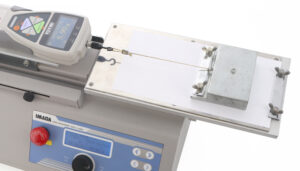
Friction testing and wear testing are very similar tests, but their purposes differ greatly. While friction testing aims to measure frictional force and the coefficient of friction, wear testing aims to measure the amount of wear caused by friction (changes in volume or mass) and changes in physical properties (frictional force, coefficient of friction, gloss, etc.). In this article, we explain the difference between friction testing and wear testing while describing an overview of each test.
For a more detailed explanation of coefficient of friction measurement (friction testing), please refer to the linked article below.

What Is Friction Testing? | Test Purpose and Method
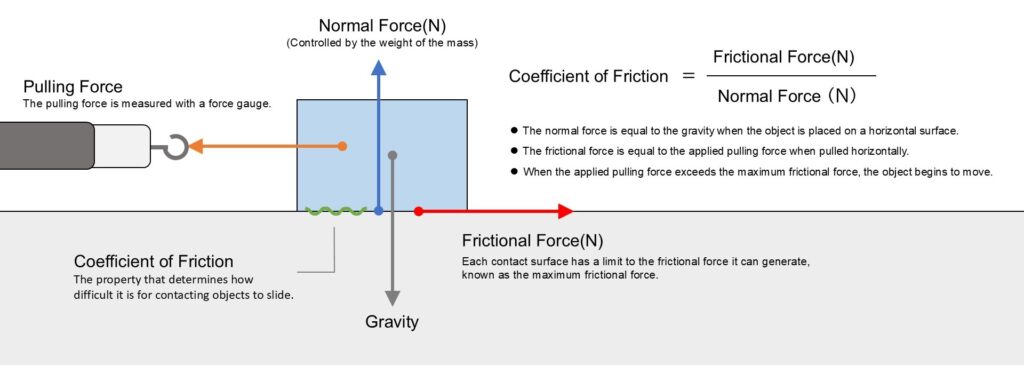
Friction testing is a test intended to measure frictional force and the coefficient of friction.
- Frictional force: the force that resists motion when attempting to slide two contacting objects against each other
- Coefficient of friction: an index of how difficult it is for the contact surfaces of two objects to slide (the higher the coefficient of friction, the higher the frictional force that can be generated)
The slip resistance of products, including materials and components, affects various aspects of quality such as workability in the manufacturing process and operability of the final product. Therefore, measured frictional force and coefficient of friction are used for quality control, material selection, and other purposes.
[How to Calculate the Coefficient of Friction]
Frictional force can be measured by actually sliding materials against each other using a force gauge (a force measuring instrument). On the other hand, the coefficient of friction cannot be measured directly. Therefore, after measuring the frictional force during sliding motion, it must be calculated using the following formula:
Coefficient of friction = Maximum frictional force (N) / Normal force (N)
What Is Wear Testing? | Test Purpose and Method
One reason frictional force occurs is the fine unevenness (microscopic asperities) on the surface of objects. Adhesion and scratching between these asperities on the surfaces lead to resistance against sliding motion. In fact, from a microscopic perspective, adhesion and scratching between asperities cause the destruction of the surface asperities of the objects. This destruction of the object surface is called wear, and it causes changes in surface condition. (Heat generated by friction is also a cause of wear.)
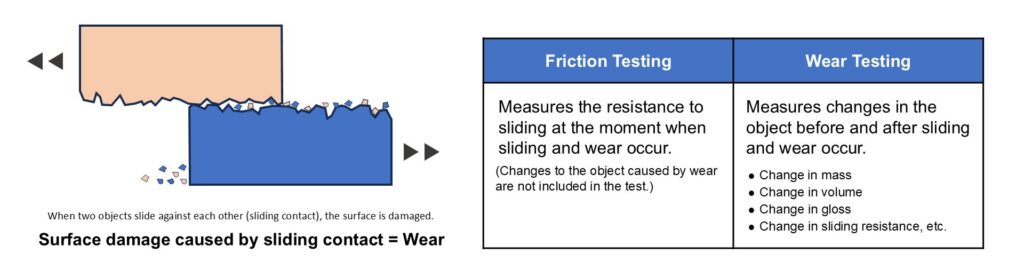
Wear testing aims to evaluate the effects of wear—caused by the factors described above—on a material or component. Effects on an object include, for example, changes in volume, mass, and physical properties (coefficient of friction, gloss, etc.). In particular, wear amount (the amount of volume reduction) is an observation target in many wear tests. Specifically, changes in mass or volume before and after the test are measured using a weighing scale or other appropriate instruments. It is also relatively common to measure changes in the coefficient of friction. For example, for flooring materials, it is measured how the coefficient of friction (slip resistance) changes due to wear caused by repeated human walking.
- Friction testing = measurement of current slip resistance (measuring frictional force and coefficient of friction)
- Wear testing = measurement of changes caused by friction (measuring changes in volume, mass, and physical properties before and after friction)
To measure the effects of wear on an object, frictional loading is naturally required. Methods to generate friction include rotary types (pin-on-disk, ring-on-disk, etc.) and linear reciprocating types; here, we introduce the linear reciprocating sliding test.
[Linear Reciprocating Sliding Test]
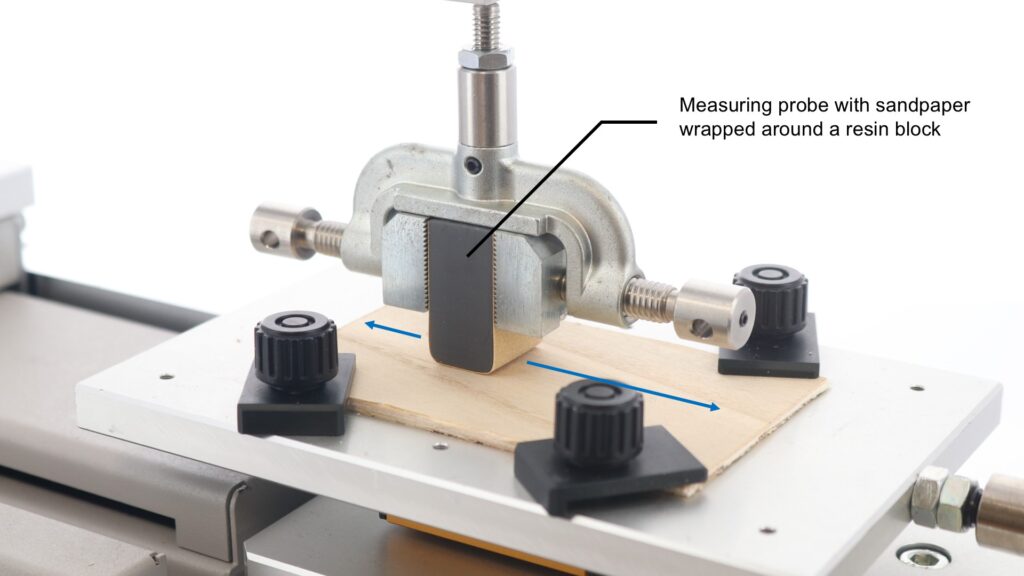
In a linear reciprocating sliding test, friction is generated by repeatedly sliding an object left and right while maintaining a constant normal force. For example, the image below shows a wear test (linear reciprocating sliding test) using a wooden board and sandpaper. Sandpaper in contact with the wooden board under a constant force moves left and right, generating friction on the sample.
For reference, in this test, frictional force was measured while performing 50 reciprocating cycles over a distance of approximately 6 cm. The graph below shows the transition of frictional force during the 50 reciprocating cycles. Below the graph, changes in the coefficient of friction due to repeated friction are also shown. (Frictional force when moving to the left is measured in the positive direction, and frictional force when moving to the right is measured in the negative direction.)
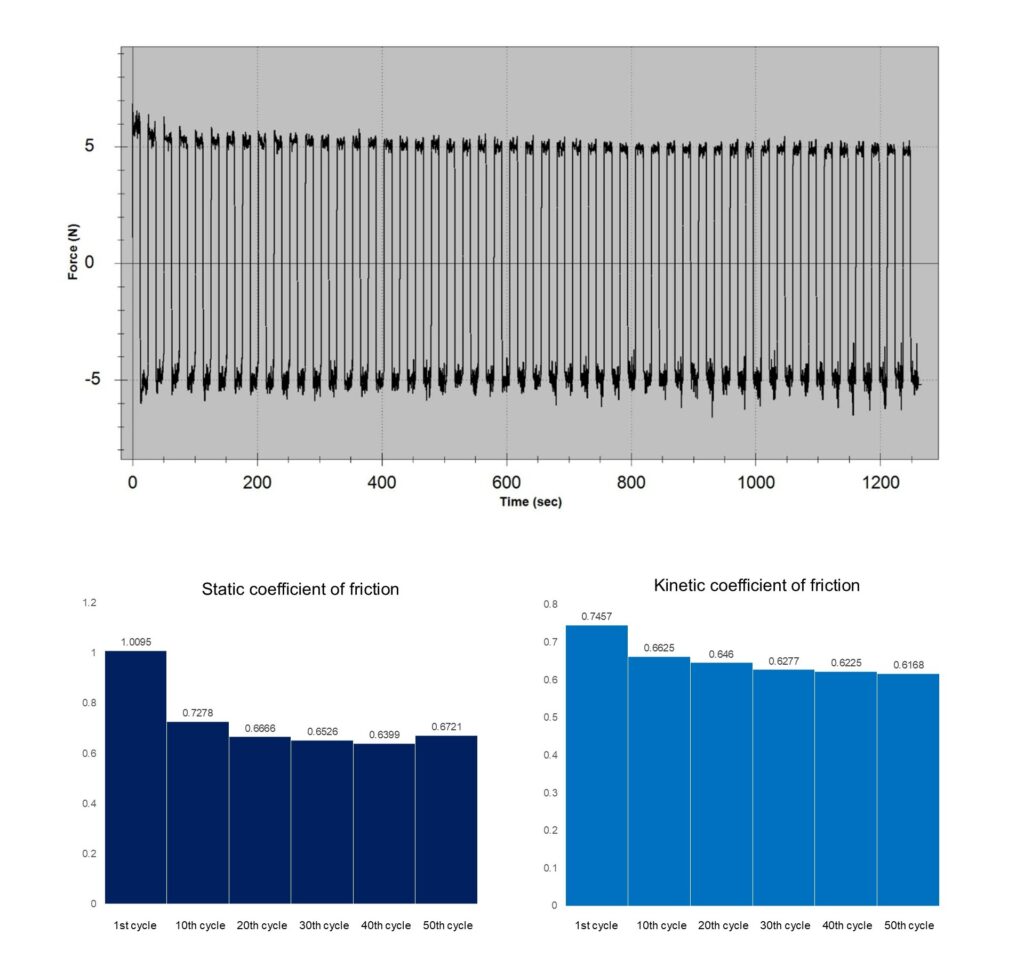
From the measurement results, it is possible to analyze wear characteristics as follows:
- Wear occurs due to friction and the surface condition changes (the coefficient of friction changes significantly between the 1st and 50th reciprocating cycle).
- Changes in surface condition are strongly influenced by initial friction (the amount of change in the coefficient of friction decreases as friction is repeated; it is inferred that the wear transitions from initial wear to steady-state wear).
Points to Note in Wear Testing
It is important to note that wear caused by friction occurs on both of the contacting objects.
For example, in the previously introduced test using a “wooden board and sandpaper,” wear occurs not only on the wooden board but also on the sandpaper. Therefore, even if the coefficient of friction decreases due to repeated friction, it cannot be concluded that the surface of the wooden board has become smoother. If the purpose of the test is “evaluation of the abrasive performance of the sandpaper,” it is necessary to observe only the changes in the wooden board before and after the test. One example is to measure and compare frictional force and the coefficient of friction against artificial skin before and after the test.
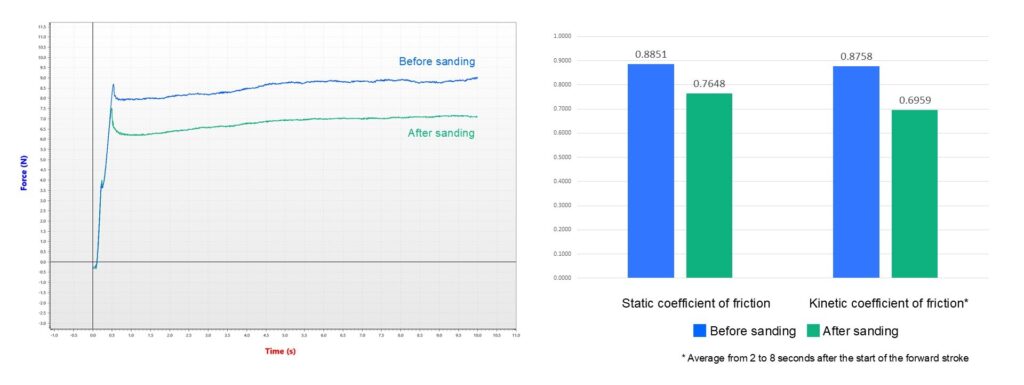
The figure above is a graph of frictional force measurements between the wooden board and artificial skin before and after sanding with sandpaper. On the right side of the graph, changes in the coefficient of friction before and after sanding are also shown. From the test results, it can be confirmed that frictional force and the coefficient of friction decrease after sanding. In other words, it is considered that sanding changed the surface of the wooden board, making it smoother.
Differences Between Friction Testing and Wear Testing (Summary)
In this article, we explained an overview of each test, focusing mainly on the difference in purpose between friction testing and wear testing.
The purpose of friction testing is to measure slip resistance (frictional force and coefficient of friction), while the purpose of wear testing is to measure changes in surface condition due to friction (wear amount and changes in physical properties). It is necessary to understand the difference in purpose and use friction testing and wear testing appropriately.
| Friction testing | Wear testing | |
|---|---|---|
| Test purpose | Measurement of slip resistance | Measurement of surface changes due to friction |
| Indicators measured | Frictional force, coefficient of friction | Changes in volume, mass, physical properties (coefficient of friction, etc.) |
| Test motion | Single sliding (sliding motion) | Repeated sliding |
Friction testing and wear testing are very similar in terms of test motion itself. Therefore, it is fairly common for friction testing and wear testing to be conducted simultaneously. Also, depending on the measurement target, it may be possible to measure wear using a friction testing machine.
IMADA manufactures and sells friction testing equipment, and also publishes many measurement application videos for friction testing on its product and service website. If you are interested in friction testing and coefficient of friction measurement, please view the video list from the link below.