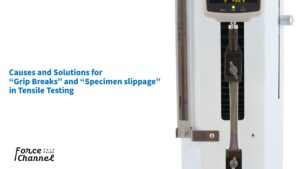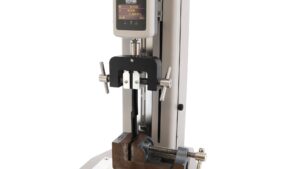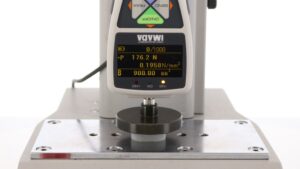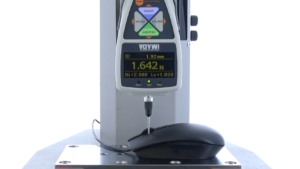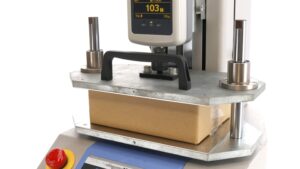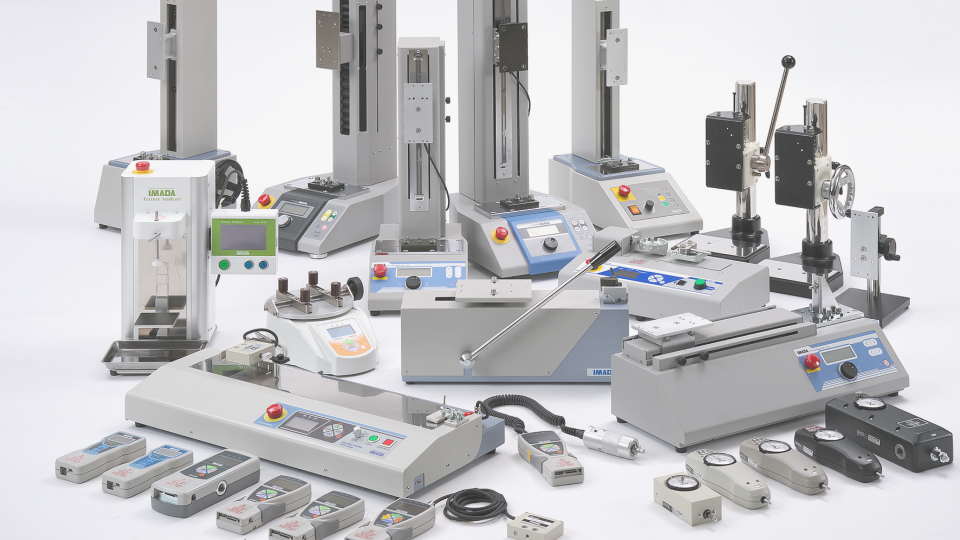
In the fields of manufacturing and materials research, the measurement of the “force used to push and pull objects” is widely utilized for the purposes of quality control and evaluation of material properties. In this article, we will explain the measurement of “pushing force” and “pulling force” step by step, from the basic concept of force to the purposes of measurement, methods, and examples of practical applications.
(For an overview of this article, please see the image below. Also, if you would like to quickly learn about measurement methods, please start from “3. Methods for Measuring Pushing and Pulling Forces.”)
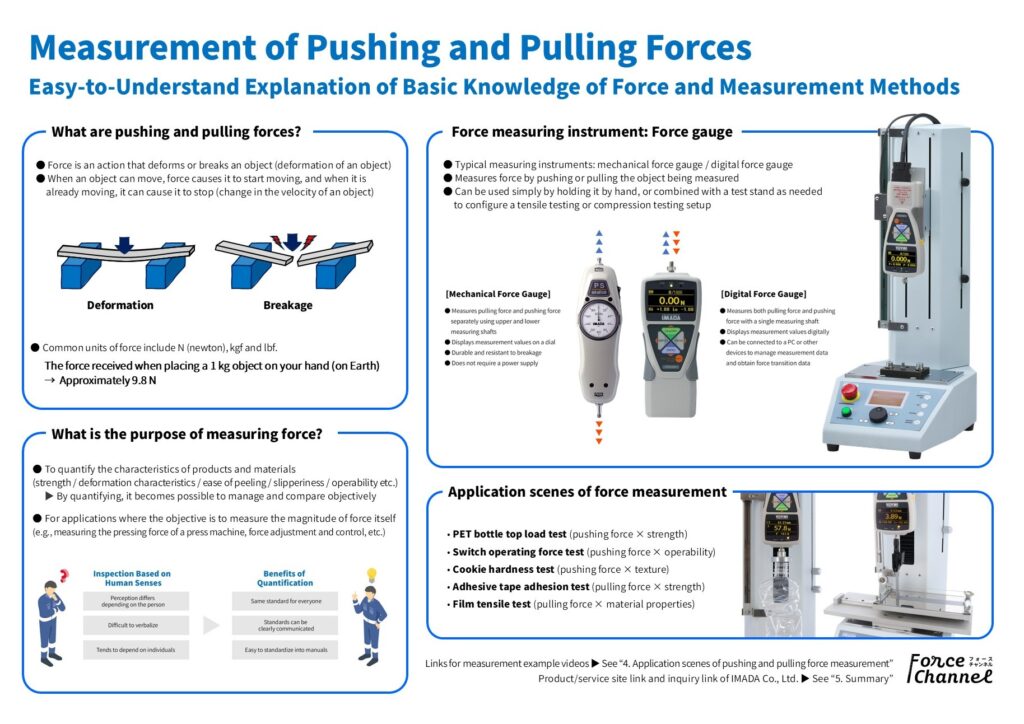
Basic Knowledge of Pushing and Pulling Forces
Before getting into measurement, let us first consider what “force” is in the first place.
In everyday life, we hear various uses of the word “power” or “force,” such as supernatural powers or the power of insensitivity, but on Force Channel, force is explained as “an action that deforms an object” and “an action that changes the velocity of an object.” In other words, when an object is at rest, the greater the applied force, the more the object being acted upon deforms, and in some cases it may even break. (If the object is free to move, it begins to move when acted upon by force. Also, when force is applied to something that is already moving, its speed may increase or its motion may stop. This is what is meant by “a change in the velocity of an object.”)
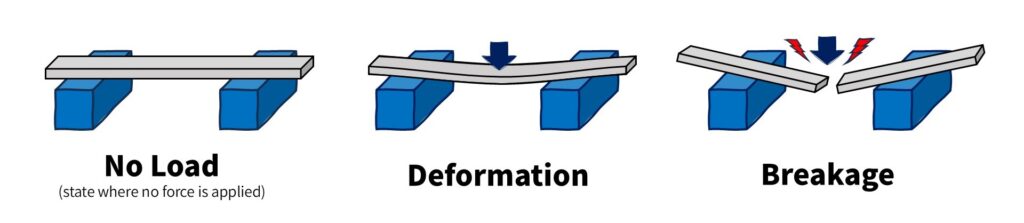
In the field of measurement, force is also sometimes referred to as “load,” however, the measurement of force/load is commonly called “force measurement.”
“Load” refers to the force an object receives from the outside. For example, you may have heard the term load capacity. Strictly speaking, there is a difference between “force” and “load,” but at an introductory level, it is fine to think of “load = the force that pushes or pulls an object from the outside.”
Unit of Pushing and Pulling Force: N (Newton)
To understand force measurement, the topic of “units” is indispensable. Units of force include N (newton), kgf (kilogram-force), and lbf (pound-force). There are differences depending on the country and industry, but globally, N (newtons) are generally used.
In physics, 1 N is explained as “the force that causes an acceleration of 1 m/ S² in an object with a mass of 1 kg,” but at an introductory level, it is enough to remember the following image:
The force received when a 1 kg object is placed on your hand (on Earth)
= approximately 9.8 N
If you keep this reference in mind, then for example, when you hear “it broke when a force of 100 N was applied,” you will be able to quickly convert that in your mind into something like, “I see, it would break if a weight of about 10 kg were placed on it.”
What You Can Learn by Measuring Force
As mentioned at the beginning, force measurement is widely used in the fields of manufacturing and materials research. In this chapter, we will look at “why force measurement is used” and “what can be learned through force measurement.”
Why Is Force Measurement Used in Manufacturing?
The need for comparison and control using numerical values is the primary reason force measurement is performed. Comparison and control by numerical values has long been practiced, but in recent years its importance has increased even further due to the following background factors:
[Increasing demands for quality control]
In today’s market, intensified competition has made “having few defects” no longer enough to stand out. In addition, quality problems have become more risky for companies than ever due to increased legal regulations, rising compliance requirements, and the spread of social media. Against this social backdrop, there is a growing need to manage quality numerically in order to prevent quality problems before they occur.
[Aging skilled workers, and the spread of robots and AI]
Another background factor is the need to quantify and document the skills of experienced workers. To pass skills on to the next generation and to replace operations with robots and the like, efforts are being made to clearly document know-how. For example, in the food industry, there are movements to quantify by force measurement the texture that craftsmen have traditionally judged by feel as “just right.”
[Difficulties in management due to globalization]
As business becomes more globalized, quality control has become more complex than before. For companies with production sites in multiple countries, it is not easy to standardize quality levels across sites. In the presence of language and cultural barriers, sharing quality standards through numerical values is playing an increasingly important role.

What Can Be Quantified by Force Measurement?
There are two major ways of thinking about force measurement depending on the purpose.
[1. When you want to know how much force is being applied]
The first is measurement aimed at “quantifying the force itself.”
Examples include the following measurements:
- Measuring the force produced by a certain movement (examples: the pushing force of a press machine, measurement of human physical ability, etc.)
- Measuring for the adjustment and control of force (example: maintaining a force of 100 N for 30 seconds*1, etc.)
*1 In manufacturing settings, many measurements are performed for the purpose of adjusting or controlling force. Tests that inspect product durability often specify conditions such as maintaining a constant load for a fixed period of time.
[2. When you want to know how much force causes a change to occur]
The second is measurement aimed at “quantifying the characteristics of products and materials” based on the changes caused by force.
- Measuring the force at which deformation occurs (examples: tensile testing of springs, bending tests, etc.)
- Measuring the force at which something breaks (examples: product strength testing, adhesive force measurement, etc.)
- Measuring the force at which something starts moving or begins to travel (examples: friction force measurement, switch operability testing, etc.)
In particular, because there are many types of measurements for “quantifying product/material characteristics,” a table extracting representative examples is shown below.
| Quantification of Strength | Quantification of Deformation | Quantification of Ease of Peeling |
|---|---|---|
| Quantifying the force at which something breaks when pushed/pulled (e.g., load capacity of a bag handle) | Quantifying how much something deforms when pushed/pulled with a given force (e.g., crushing / bending / elongation) | Quantifying the force required to peel something off by pulling (e.g., ease of opening a cup container) |
| Quantification of Slip Resistance | Quantification of Operating Force | Quantification of Texture |
|---|---|---|
| Quantifying the force at which something begins to slip and move when pushed/pulled (e.g., floor slip resistance) | Quantifying the force required for operation when pushed/pulled (e.g., brake operating force) | Quantifying, for example, the force at which a food product breaks when pressed (e.g., cookie hardness measurement) |
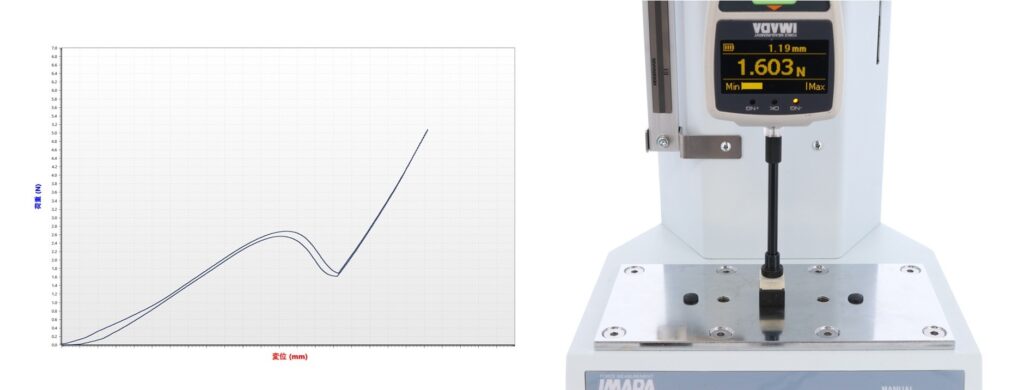
In more advanced measurements, product and material characteristics may be analyzed from “force fluctuations.” For example, have you ever felt that when you press a computer keyboard key or similar, the pushback force suddenly drops with a little click?
In push-button switches such as keyboards, the typing feel*2 is created by this change in pushback force. For this reason, in the keyboard industry, “force fluctuations” are quantified through measurement for the purpose of analyzing and controlling typing feel.
*2 Typing feel refers to the “sensation” when pressing a keyboard. It is also sometimes called switch feeling. Sound, vibration, and light feel are also factors that affect typing feel, but fluctuations in pushback force are also one of the major factors influencing “typing feel.”
Methods for Measuring Pushing and Pulling Forces
So far, we have looked at the basic concept of force and the purpose of measurement.
From here, we will introduce specific methods for measuring “pushing force” and “pulling force.”
Tools for Measuring Force (Force Gauge)
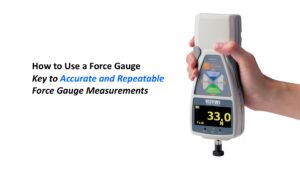
Among tools for measuring force, the force gauge is well known.
There are two types of force gauges: mechanical force gauges using a spring mechanism (also called push-pull scales), and digital force gauges that contain a load cell (a sensor that measures force). Although their mechanisms differ, both share the same point: “they measure force by pushing or pulling the object being measured.”
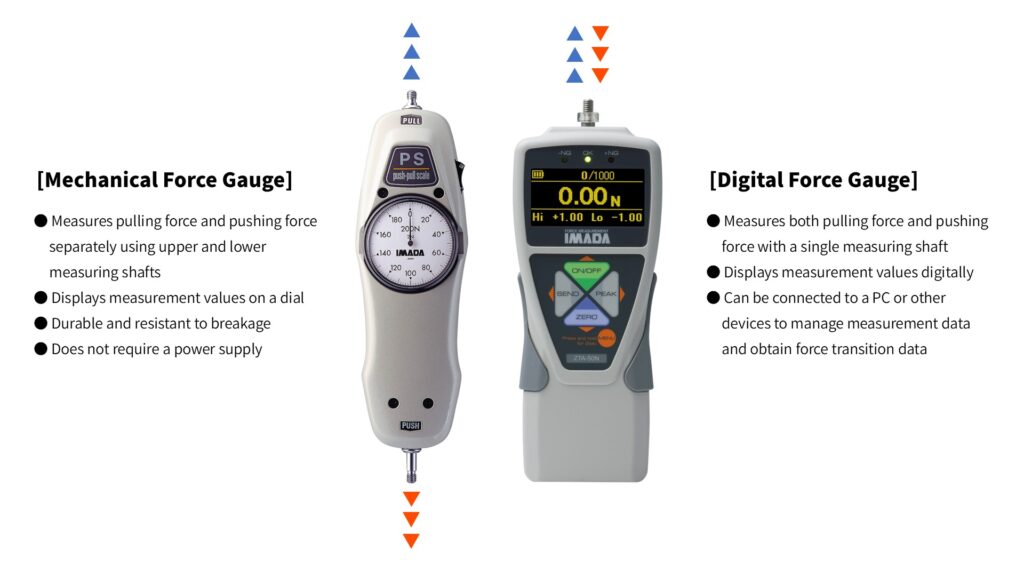
A force gauge can measure force in both directions: “pushing force” and “pulling force.” However, in actual measurement, it is necessary to attach an attachment (measuring jig) to the measuring shaft according to the shape of the object being measured and the content of the measurement. Because the attachment is the part that actually touches the object being measured, it is a very important element in force measurement.
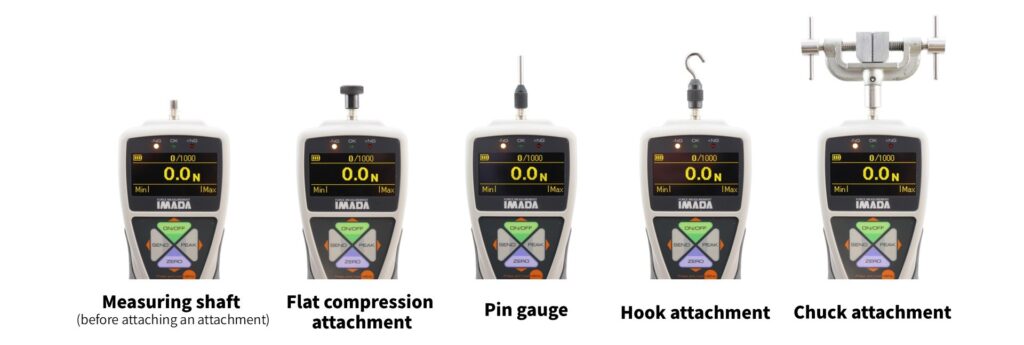
The threaded shaft visible in the far-left image is the measuring shaft to which the attachment is attached.
[Force Measuring Instruments Other Than Force Gauges]
As force measuring instruments other than force gauges, the spring scale, which measures force using the elasticity of a spring, is well known. Like a force gauge, it is a tool for measuring force by pushing or pulling the object being measured, and it features a simple structure that is resistant to breaking. Compared with mechanical force gauges, it is often inferior in terms of accuracy and functionality, but it still has steady demand as an inexpensive and easy-to-handle measuring instrument.
How to Use a Force Gauge
From here, we will explain how to specifically use a force gauge.
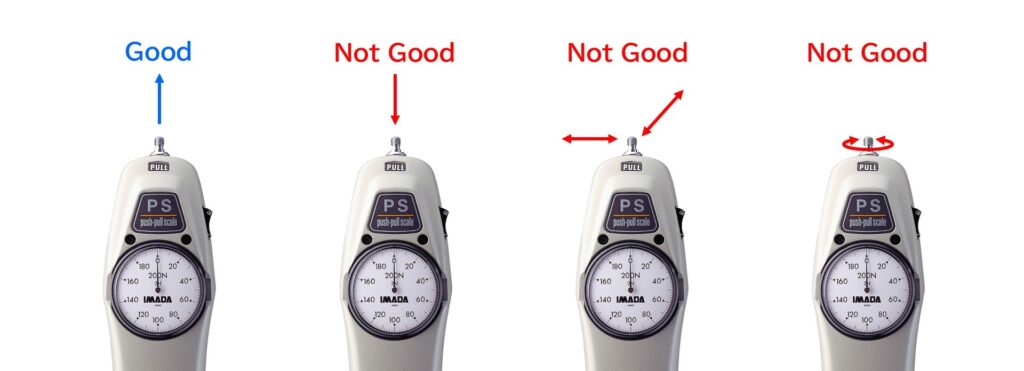
The force actually measured by a force gauge is the magnitude of the force applied to the internal mechanism through the measuring shaft. Therefore, when applying force, it is important to apply it as straight as possible (perpendicularly) to the measuring shaft. If force is applied diagonally or with twisting, not only can accurate measurement not be obtained, but it may also cause failure. In particular, in mechanical force gauges, the measuring shaft differs for pushing force and pulling force. Please note that mistakenly applying force in the opposite direction may cause failure.
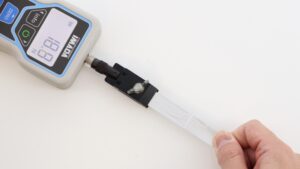
For simple measurements, the force gauge is held by hand and used to push or pull the sample. Many force gauges are equipped with a “peak hold function,” which allows you to check the maximum value (peak value) recorded during measurement while monitoring force changes in real time.
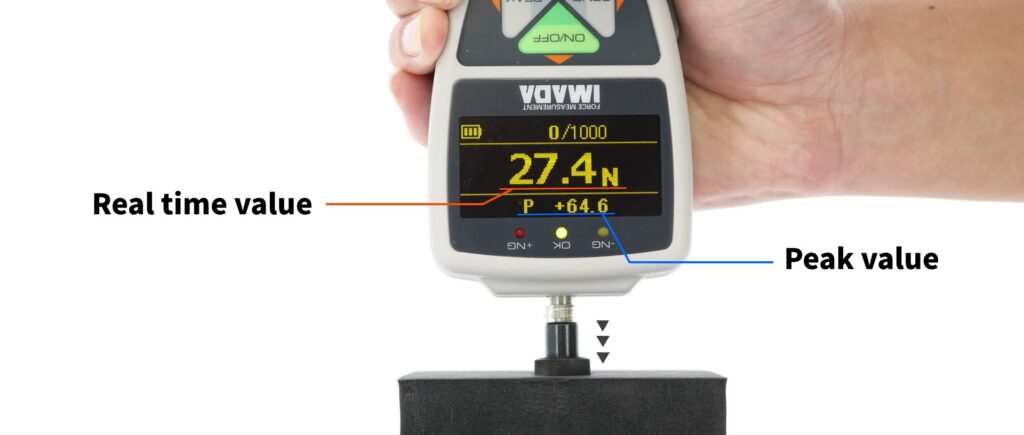
Please note that force gauges are not made to measure impact force. When applying force, take care to apply the load slowly. Precautions for using force gauges are introduced in detail in the following article as well. It summarizes content we would like first-time users of force gauges to read, so please take a look.
Measuring Force That Cannot Be Measured by Hand
For example, when dealing with forces so large that they cannot be measured by human power, the force gauge is used attached to a measuring stand. By using a measuring stand, it becomes possible to repeatedly and stably apply forces such as 500 to 5000 N (equivalent to placing a weight of about 50 to 500 kg) to the object being measured.
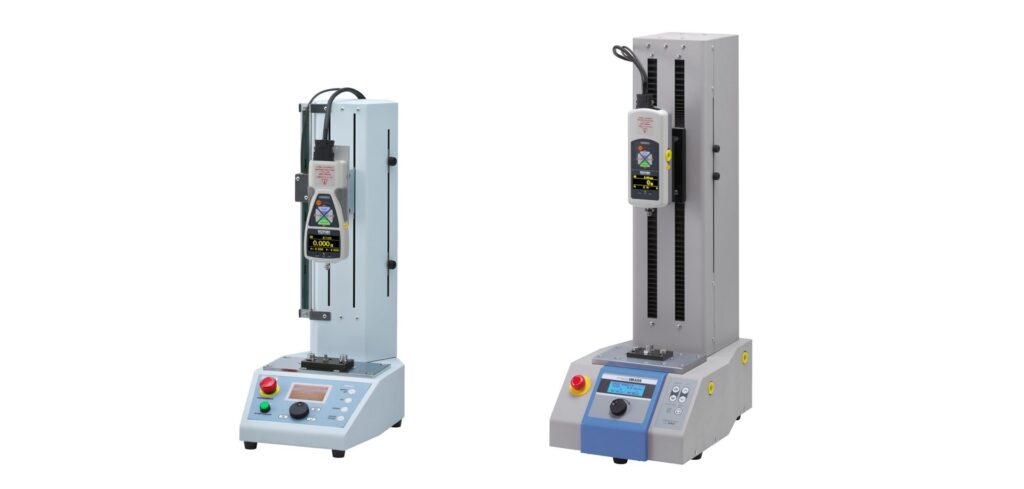
The advantages of a measuring stand are not limited to the ability to handle large forces.
A measuring stand also has the benefit of “keeping test conditions constant.” In particular, an motorized test stand can repeatedly and stably achieve test conditions that are difficult to reproduce by hand, such as keeping the test speed and pulling angle uniform or maintaining a state in which a constant force is applied. Test conditions such as test speed have a major influence on measurement results. Therefore, even for measurements that do not involve very large forces, we recommend using a measuring stand when accuracy and reproducibility are important.
[Reference for Selecting Measuring Equipment by Purpose]
・To measure pushing or pulling force simply → Force gauge
・To repeatedly measure with the direction of force aligned → Force gauge + manual test stand
・To measure with test conditions such as speed also aligned → Force gauge + motorized test stand
・To measure forces greater than human power → Force gauge + motorized test stand
・To control the force applied to the object being measured → Force gauge + motorized test stand
* Attachments and connection cables may be required for measurement. For details, please contact each measuring instrument manufacturer.
Application Scenes for Measuring Pushing and Pulling Forces
In the previous chapter, we explained methods of force measurement. Here, we will introduce how the measurement of “pushing force” and “pulling force” is actually utilized in manufacturing and materials research settings.
- Compression resistance test of PET bottles (pushing force × strength)
- Operating force measurement of switches (pushing force × operability)
- Cookie hardness measurement (pushing force × texture)
- Adhesive force measurement of adhesive tape (pulling force × strength)
- Tensile testing of film (pulling force × material properties)
Compression Resistance Test of PET Bottles (Pushing Force × Strength)
For packaging containers such as PET bottles, compression resistance tests (tests in which they are crushed from above) are performed to confirm how much force they can withstand during transportation and storage. This test is also called a “top load test.” Depending on the manufacturer, measurements are also taken of the force required to crush them from the side.
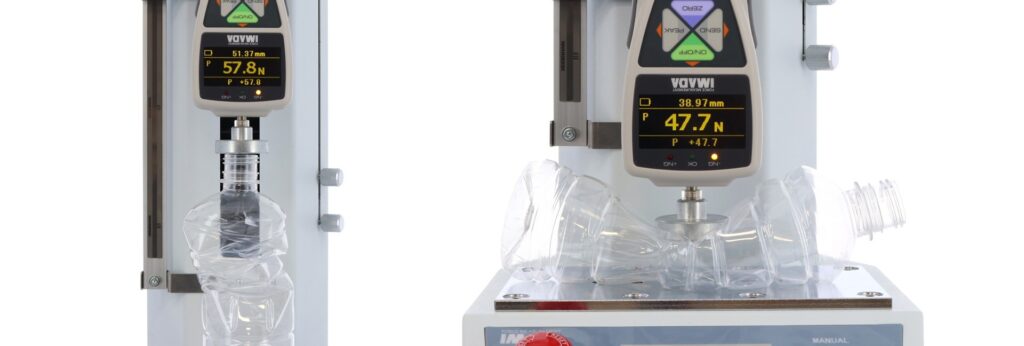
Especially for PET bottles, where weight reduction is progressing, achieving both lighter weight and strength is a major challenge. In addition, from the perspective of reducing waste volume, “ease of crushing after drinking” is also required. Against this background, force measurement is used to quantify the force required to crush them.
>> Watch the video of the compression resistance test of PET bottles
Operating Force Measurement of Switches (Pushing Force × Operability)
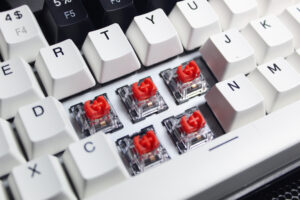
The pushing force required to operate a switch (ON/OFF) is also one of the forces measured in product development and quality control settings. The operating force of a switch has a major impact on product ease of use and user feel. In particular, it is known that the click feel of push-button switches (the sensation that allows the user to intuitively recognize that the switch has turned on) is greatly related to changes in pushback force, and it is therefore a subject of research and quality control.
>> Watch the video of switch operating force measurement
Cookie Hardness Measurement (Pushing Force × Texture)
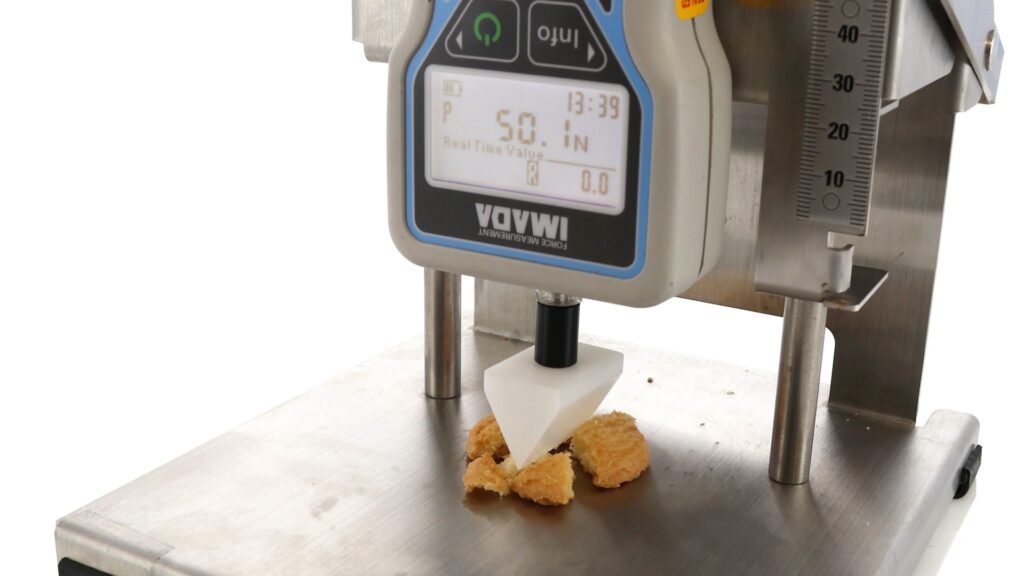
Numerical control through force measurement is also progressing in the field of food texture. One example is the measurement of cookie hardness. In hardness measurement, the cookie is crushed using a force gauge, and hardness is evaluated by checking the force at the moment it breaks. Such pushing force measurements are also used to evaluate the hardness of foods for people with swallowing difficulties and universal foods.
>> Watch the video of cookie hardness measurement

Adhesive Force Measurement of Adhesive Tape (Pulling Force × Strength)
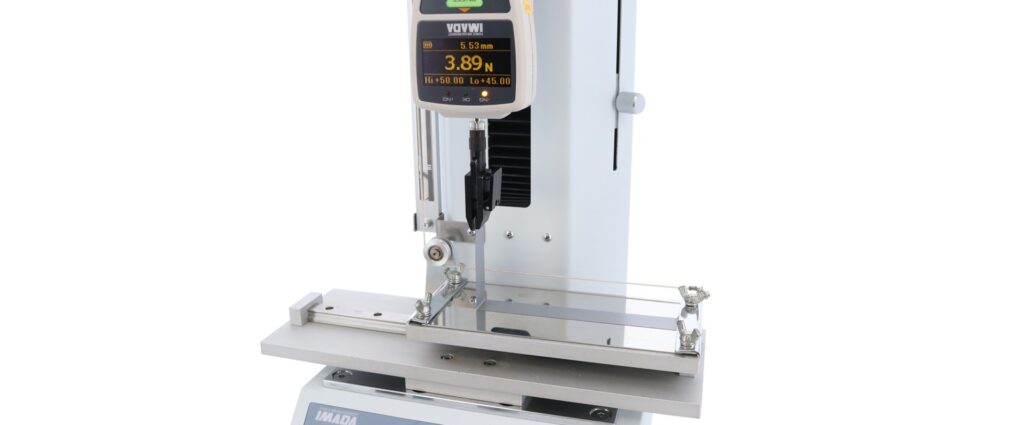
Adhesive tape is one of the products for which “quality quantification through pulling force measurement” has progressed the most. In particular, adhesive force is often clearly specified as a product specification, and there are also multiple standards (JIS, ISO, etc.) that define measurement methods.
Adhesive force measurement is carried out by using a force gauge to peel adhesive tape off a stainless steel panel or similar. Although it appears simple, it is actually a deep test, as the measured value changes depending on the peeling angle and speed.
>> Watch the video of adhesive force measurement of adhesive tape

Tensile Testing of Film (Pulling Force × Material Properties)
Finally, we introduce tensile testing of film. This test is conducted for the purpose of quantifying material properties such as tensile strength and stretchability. Plastic films are used in a very wide range of applications, and the required properties vary depending on the application. For this reason, force measurement is widely used to quantify various properties of plastic films, including not only tensile testing but also evaluations of puncture strength and slipperiness.
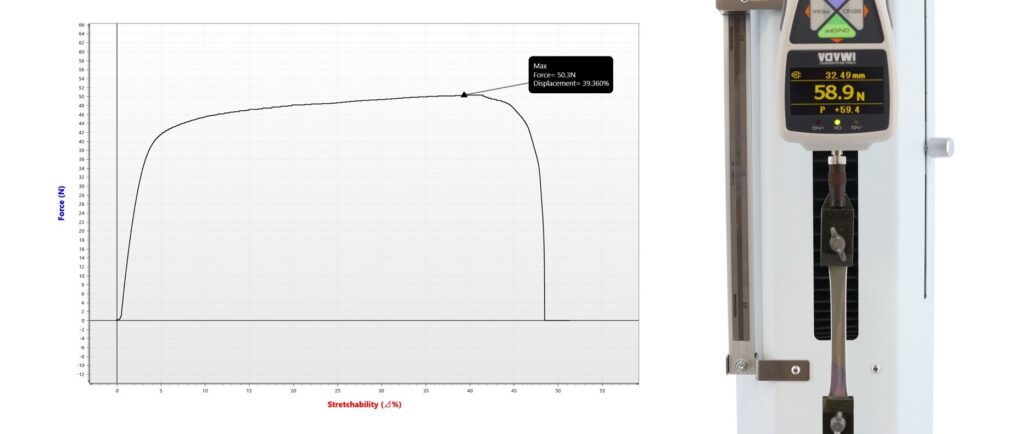
>> Watch the video of tensile testing of film
Summary
In this article, we have explained the measurement of “pushing force” and “pulling force,” from the basic concept to measurement methods and application examples. The quantification of quality and material properties through force measurement is becoming increasingly important against the background of changes in the environment surrounding society. The content introduced in this article is only a part of force measurement. The fields that can be quantified through force measurement are still continuing to expand into various areas even now.
Force Channel will continue to provide information on the theme of “force measurement.” If this article has sparked your interest in force measurement, please take a look at our other articles as well.
[Reference Information]
IMADA Co., Ltd. manufactures and sells a wide range of products such as the “force gauges,” “attachments,” and “measuring stands” introduced in this article. If you are interested in measuring instruments, please visit our product and service website via the link below.
>> See IMADA’s product and service website
In addition, if you are wondering, “I want to measure this kind of force, but what should I do?” or “I want you to propose equipment suited to our sample,” we also provide assistance with equipment selection. If you would like to consult with us, please contact us via the link below.